

The workers were nice and professional. The wait was short. The only problem I had is because it is very far from where I live. I wish there was one that was closer.
Read More
I Lost My Vaccine Records… Now What? Do I Really Have to Get All Those Shots Again?
Posted: Oct 6th, 2026 at 12:00AM
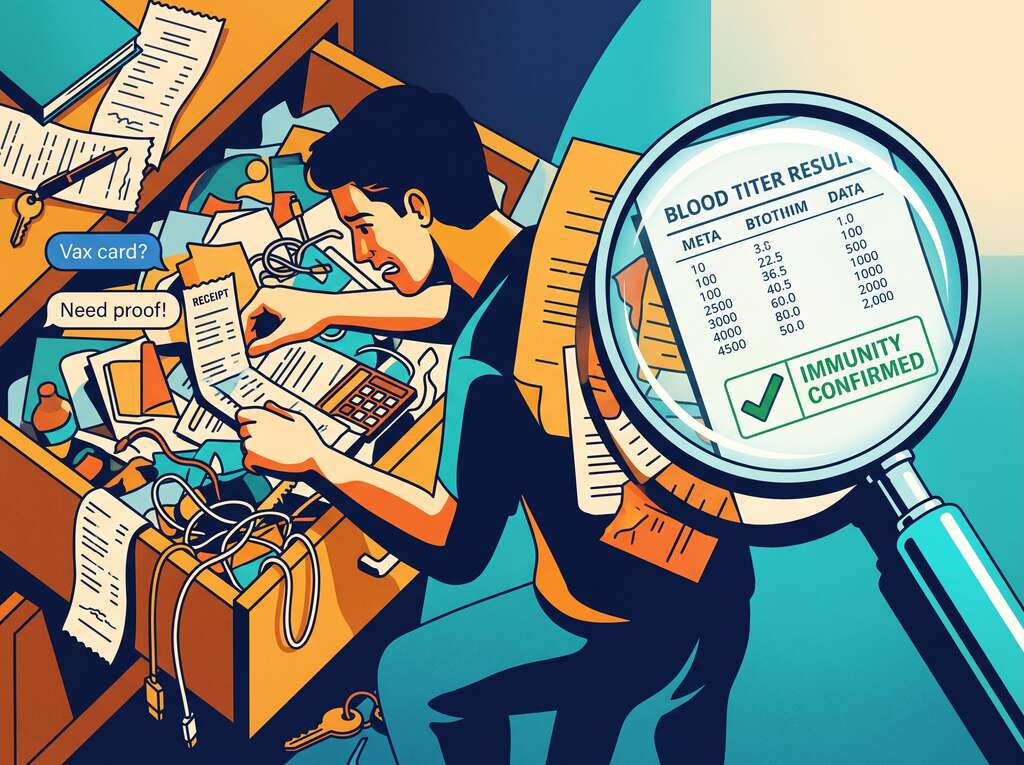
You checked the junk drawer. You texted your parents. You searched your email for “vaccine,” “immunization,” and every spelling of “hepatitis” you could think of. Still nothing.
Losing vaccine records is frustrating, especially when a school, employer, clinical program, or travel plan suddenly requires proof that you are protected. The good news is that a missing piece of paper does not always mean you have to start from scratch.
There are several ways to figure out what you have already received, what you may still need, and whether a blood titer can help prove immunity. The key is to stop guessing and work from the requirements in front of you.
First question: what exactly are you being asked to prove?
Before doing anything, look closely at the form, checklist, email, or portal from your school or employer. Some organizations want a documented vaccine series. Others will accept laboratory proof of immunity for certain diseases. Some require both a vaccination history and additional testing.
Bring the actual requirement with you whenever possible. It is much easier for a clinic to help you build the right plan when the exact instructions are available.
Can old vaccine records be found somewhere else?
Sometimes. Depending on where and when your vaccinations were given, records may be available through a state immunization registry, a former physician, pediatric office, pharmacy, school, military record, previous employer, or another health system.
That does not mean every vaccine you have ever received will automatically appear in one database. Older records, vaccines given in another state or country, and records from clinics that did not report electronically may be missing. But it is worth checking before assuming the records are gone forever.
What is a blood titer, and can it help?
A blood titer is a laboratory test that can measure whether your immune system shows evidence of immunity to certain infections. Depending on the requirement, a titer may be accepted as proof of immunity for diseases such as measles, mumps, rubella, varicella, or hepatitis B.
A titer is not the same thing as a vaccine record, and it is not the right solution for every vaccine. Whether it can be used depends on the disease being tested and the rules of the school, employer, program, or agency requesting documentation.
This is why it helps to have your requirements reviewed before ordering random tests.
What if my titer says I am not immune?
A result showing that you do not have the required evidence of immunity does not mean you did anything wrong. It simply means your next step may include vaccination or additional follow-up based on the requirement and a clinician’s recommendation.
For students and employees working toward a deadline, knowing this early can be especially important because some vaccines are given as a series rather than a single dose.
Do I have to restart a vaccine series if I am late?
Usually, an extended gap between recommended doses does not automatically mean the entire vaccine series must be restarted. The right next dose and timing depend on the vaccine, your age, your health history, and the reason you need it.
If you received one or two doses years ago but cannot remember what came next, bring any documentation you do have. Even one old record can be helpful.
How e7 Health can make this easier
e7 Health can review vaccination records and school or work requirements, provide adult vaccinations, draw blood titers when appropriate, and help patients plan multi-dose vaccine series. For students, e7 Health also offers services such as TB testing, school physicals, drug testing, and other common health requirements in one location.
The goal is simple: figure out what you actually need instead of repeating services unnecessarily or discovering a missing requirement at the last minute.
Before your appointment, bring:
- Any vaccine records you can find, even if they look incomplete
- Your school, employer, clinical, or program requirements
- A list of previous clinics, pharmacies, or states where you may have been vaccinated
- Your identification and any forms that need to be completed
- Questions about deadlines, vaccine series, or acceptable proof of immunity
The bottom line
Missing vaccine records are annoying, but they do not have to turn into a scavenger hunt followed by a pile of unnecessary shots. Start with your exact requirement, gather whatever records you can find, and let a healthcare professional help you determine whether documentation, titers, vaccination, or a combination of these is appropriate.
Need help sorting out your vaccine requirements? e7 Health offers same-day and next-day appointment availability for many services and allows patients to book online.

(Translated by Google) This is the best clinic I've ever visited. I went for some work-related tests and they treated me with so much kindness and respect. They have a fantastic team. Google won't let me leave a second review. I went a second time and they treated me just as well as always, with great kindness and professionalism. They make everything easy for you at our clinic, and they have a fantastic staff. Ms. Fernanda was a true professional. Thank you to all the doctors for making things so easy for us. (Original) Esta es la mejor clínica que he visitado. Fui hacerme un exámenes para mi trabajo y me atendieron con mucho amor y respeto, tienen un equipo de trabajo fantástico, google no me deja hacer una segunda reseña. Fui por segunda vez y me atendieron igual que siempre aquí con muchas amabilidad y profesionalismo a nuestra clínica porque esto te lo hacen fácil además de eso no tienen un gran personal profesional . La señorita Fernanda fue una gran profesional en su atención. Gracias a TODOS LOS DOCTORES POR HACERNOS LAS COSAS FACILES
Read More
Clean & professional
Read More