

The workers were nice and professional. The wait was short. The only problem I had is because it is very far from where I live. I wish there was one that was closer.
Read More
My Titer Came Back Negative — Now What?
Posted: Sep 1st, 2026 at 12:00AM
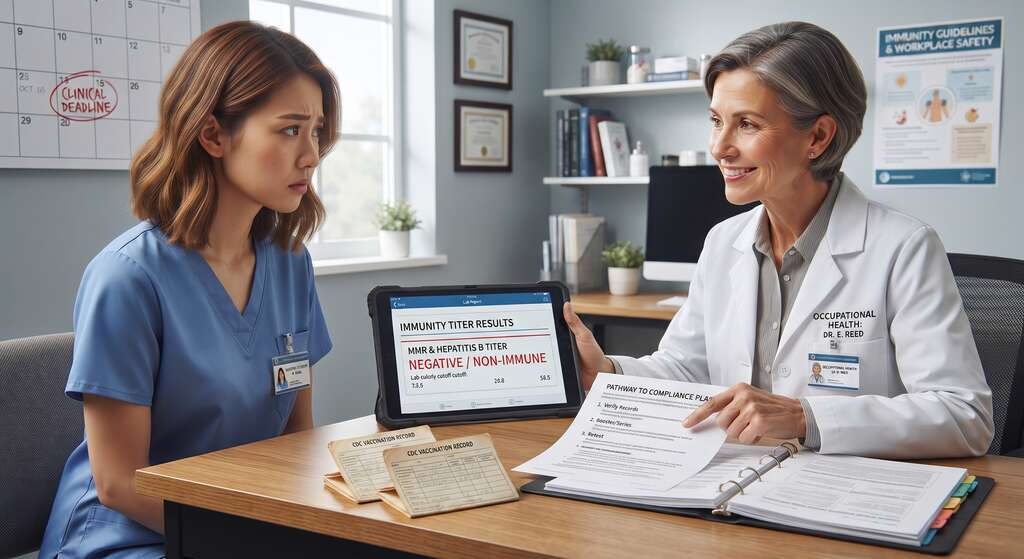
You submitted a titer for your nursing program, your clinical rotation, or a new job in healthcare, and the result came back as negative, non-immune, or equivocal. Your deadline is probably close. Here is the reassuring part: this is common, it usually does not mean your childhood vaccines failed, and in most cases the fix is straightforward.
What the fix is, though, depends entirely on which titer came back negative.
What a Negative Titer Actually Means
A titer measures the concentration of specific antibodies circulating in your blood right now. It is a snapshot of one part of your immune system.
Antibody levels naturally decline over time. If you were vaccinated as a child, twenty or thirty years may have passed since your last dose, and measurable antibodies can fall below a lab's cutoff even though your immune system still remembers the pathogen. Immune memory lives in cells that a titer test does not measure. On top of that, the commercial assays used for routine screening are not always sensitive enough to detect vaccine-induced immunity, which is somewhat lower than immunity produced by natural infection.
So a negative titer means "antibodies were not detected above the threshold." It does not necessarily mean "you are not protected."
Start Here: Do You Have Your Vaccination Records?
Before anything else, find out whether you can document your childhood or prior vaccinations. This single question determines what happens next, and for measles, mumps, rubella, and varicella it matters more than the titer result itself.
Check your patient portal, your parents' files, your high school or college health office, your state immunization registry, or a previous employer's occupational health department. It is worth an hour of searching.
MMR: The Result That Surprises People
Here is where CDC guidance runs counter to what most people expect.
For healthcare personnel with two documented doses of MMR, the CDC does not recommend serologic testing at all. And if such a person is tested anyway and the measles, mumps, or rubella result comes back negative or equivocal, CDC guidance states they should still be considered to have presumptive evidence of immunity and are not in need of additional MMR doses. Documented age-appropriate vaccination supersedes the results of subsequent serologic testing.
In plain terms: if you have two documented MMR doses on record, a negative titer does not, under federal guidance, mean you need another shot.
There is one important exception. A woman of reproductive age who could become pregnant and has a negative or equivocal rubella titer should receive a third dose of MMR. This is because of the risk congenital rubella poses in pregnancy, and it applies regardless of documented doses.
If you cannot document two prior doses, the path is different — you would receive two doses of MMR at least four weeks apart.
Varicella: The Same Principle Applies
Acceptable evidence of varicella immunity for healthcare personnel includes documentation of two doses of varicella vaccine given at least twenty-eight days apart, a physician-diagnosed history of chickenpox or shingles, or laboratory evidence of immunity.
As with MMR, documented two-dose vaccination is itself evidence of immunity. Routine varicella titers frequently come back negative in people who were vaccinated as children, largely because the standard assays struggle to detect the lower antibody levels vaccination produces. If you have no documentation and no history of chickenpox, vaccination is the standard path.
Hepatitis B: This One Is Genuinely Different
Do not apply the logic above to hepatitis B. Here, the number actually matters, and documented vaccination alone is not the endpoint.
Protection is defined as an anti-HBs level of 10 mIU/mL or higher, measured one to two months after the final dose of a complete series. If your result is below 10 mIU/mL after a documented three-dose primary series, CDC guidance calls for revaccination with a second complete series, followed by anti-HBs testing one to two months after the final dose.
Some encouraging context: roughly thirty to fifty percent of people who did not respond to a first series do respond to a second one. Many people simply need the additional exposure.
If your level remains below 10 mIU/mL after six total doses, you meet the definition of a non-responder. At that point, testing for hepatitis B surface antigen is recommended — because a common reason for non-response is that the person already has a hepatitis B infection. Non-responder status is not a barrier to working in healthcare; it changes how an exposure would be managed, and your occupational health department will document it.
One timing note that trips people up: anti-HBs testing must be done one to two months after the last dose. Testing too soon can produce a falsely low result and start an unnecessary revaccination cycle.
What CDC Says vs. What Your Program Requires
This is the part almost no article addresses, and it is the practical reality for most students.
CDC guidance sets the clinical standard. Your nursing program, clinical site, or hospital sets the paperwork standard — and the two do not always match. Many programs require a booster dose and a repeat titer after a negative result even in cases where CDC guidance would consider you immune. Clinical sites often have their own contractual requirements layered on top of the school's.
Neither party is wrong. The program is managing institutional liability, not just individual clinical risk.
The practical approach: ask your program's health compliance office exactly what they will accept before you decide anything. The three answers you need are whether documented doses satisfy them in place of a titer, whether they require a booster after a negative result, and whether they require a repeat titer after that booster. Get it in writing if you can. Then have your clinic help you meet that specific standard rather than a general one.
Plan Backward From Your Deadline
Timelines are where students get caught, particularly with hepatitis B.
A negative MMR or varicella titer requiring a booster can often be resolved in a single visit, with a repeat titer several weeks later if your program requires one. A negative hepatitis B result is a longer road: a full second series spans roughly six months, with confirmatory testing one to two months after the final dose. If your clinical rotation starts in eight weeks, you cannot complete that sequence first.
Most programs will accept documentation that the series is in progress. Start it early, get the documentation, and keep going.
Get It Sorted in One Place
e7 Health performs titer testing, administers nearly every vaccine available in the United States, and handles the follow-up documentation your program needs — all in one Las Vegas office, with same-day and next-day appointments. If your titer came back negative and you are not sure what your program actually requires, bring us the paperwork and we will help you work out the shortest path to compliance.
This article is provided for general informational purposes and is not medical advice. Immunity requirements vary by program, employer, and clinical site. Discuss your specific results with a licensed healthcare provider and confirm requirements with your program's health compliance office.

(Translated by Google) This is the best clinic I've ever visited. I went for some work-related tests and they treated me with so much kindness and respect. They have a fantastic team. Google won't let me leave a second review. I went a second time and they treated me just as well as always, with great kindness and professionalism. They make everything easy for you at our clinic, and they have a fantastic staff. Ms. Fernanda was a true professional. Thank you to all the doctors for making things so easy for us. (Original) Esta es la mejor clínica que he visitado. Fui hacerme un exámenes para mi trabajo y me atendieron con mucho amor y respeto, tienen un equipo de trabajo fantástico, google no me deja hacer una segunda reseña. Fui por segunda vez y me atendieron igual que siempre aquí con muchas amabilidad y profesionalismo a nuestra clínica porque esto te lo hacen fácil además de eso no tienen un gran personal profesional . La señorita Fernanda fue una gran profesional en su atención. Gracias a TODOS LOS DOCTORES POR HACERNOS LAS COSAS FACILES
Read More
Clean & professional
Read More